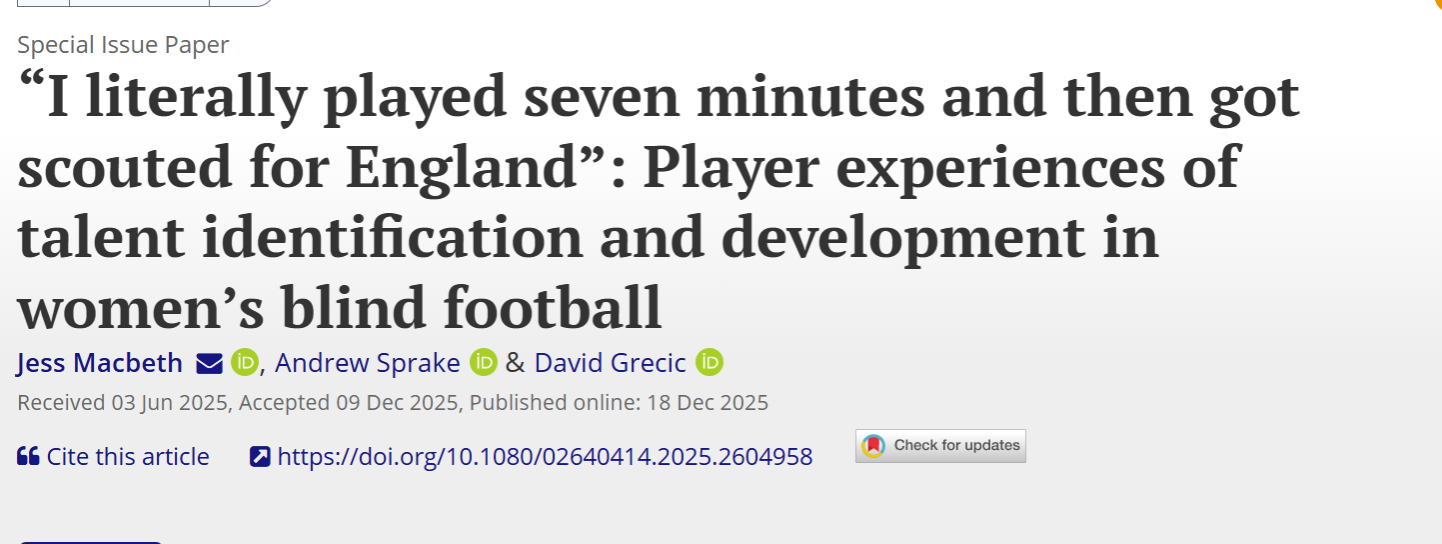
In women's blind football, seven minutes can be enough to earn a national call-up. A new study in the Journal of Sports Sciences reveals that several England development players were scouted within weeks, sometimes minutes of first trying the sport. Researchers at the University of Lancashire interviewed seven visually impaired women involved in England's pathway and found a system growing so quickly that structure often struggles to keep pace. As the women's game pushes toward greater global recognition and possible Paralympic inclusion, the findings highlight both opportunity and risk.
The research matters because women with visual impairments have historically been excluded from elite football pathways. With national squads now forming and international tournaments expanding, getting development right is critical. Poorly supported fast-tracking could lead to burnout, inequality, or athletes dropping out altogether.
Players described highly unpredictable entry points from college taster sessions to being approached in the street. Some were selected for England development camps almost immediately due to a limited talent pool. Many had to learn blind football from scratch, mastering ball control, spatial awareness, and communication under blindfold conditions. Limited infrastructure meant some trained alone or in mixed-sex leagues, while the combination of blind and partially sighted players created uneven learning experiences.
The study used in-depth interviews and a focus group to capture livedexperiences, offering rare insight into a sport still in its infancy.
"As one player told us, she played seven minutes and was scouted for England," said lead author Jess Macbeth. "That speed shows momentum — but it also shows how fragile the pathway currently is."
"If the women’s game is going to thrive," she added, "development must be deliberate, inclusive, and built around players' real needs."
Editor: Bashir Mehvish
First-Round Review Editor: Guo Enkai
Second-Round Review Editor: Peng Xiyang